Valuation
The Anatomy of a $100 ACEO
Two identical cats. Both watercolor. Both 2.5"x3.5". One sells for $4. The other closes at $115. The difference has nothing to do with brushwork. It's reputation.
ACEO prices are driven by signals outside the frame. Collectors paying a premium are buying the artist's track record, the documentation, and the rarity of the medium. Know which signals move the needle.
A typical ACEO trades in single or low double digits. The $100 tier is the rare top of the market.
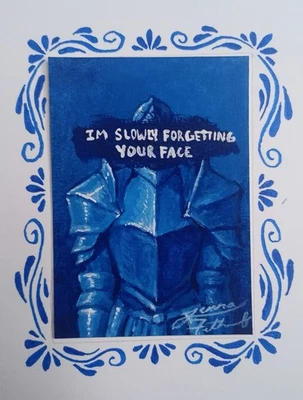
Real original ACEOs that sold for $100 or more. Tap a card for its full sale record.

1. The consistency premium
A single strong card from an unknown artist gets a glance. It does not get a bidding war. Real money follows artists who show up on a schedule with a recognizable style.
When an artist posts consistently and collectors know a Thursday drop is coming, the audience builds. The $100 card fetches $100 because 50 people are already watching the seller. This proves artists don't need a large following to make a good living selling ACEOs.
What a bidding war looks like
Real $100-plus auctions we tracked, from where the bidding opened to where it closed. The orange overhang is the premium the crowd added.
- +105%
- Average climb
- opening bid to final price
- +288%
- Biggest jump
- $58 to $225 · curiosibee
2. Documented provenance
A $100 ACEO never ships alone. It comes with a certificate of authenticity or is stamped and signed directly on the back.
Anyone can shrink an image and print it on card stock. The premium is built on trust. High-value artists hand-sign the back, number the edition, and date the work. "1 of 1." "5 of 50." Don't fall for artists selling prints as "original" work. It's fraud.
Provenance is worth a deep read on its own. See What is Provenance? for why a paper trail is non-negotiable at this tier. Selling? Our free Certificate of Authenticity generator makes a print-ready COA in a couple of minutes, no account needed.
3. The medium multiplier
Some mediums carry a price premium simply because of the skill required to work them at 2.5"x3.5".
- Oil on canvas board: Sought after for texture and the difficulty of miniature brushwork.
- Intaglio and etching: Running a press at this scale requires serious technical skill.
- Encaustic: Melted wax medium. Rare at this size. Striking in a top-loader.
Colored pencil and marker are the backbone of the market and can command good prices. But traditional mediums at miniature scale start bidding wars because they are genuinely rare.
The mediums behind the $100-plus original sales on record. Tap a medium to browse it.
The takeaway for collectors
Stop evaluating the image alone. Check the artist's sales history, the signature, and the consistency of their output. Where are they going with their career? That is where the value is.
Want proof this tier is real? See The $100 ACEO Club: every original ACEO on record that actually sold for $100 or more.
Recommended in this article
- Thick top-loaders, for encaustic and other textured pieces
As an Amazon Associate I earn from qualifying purchases.
